When Eight Legs Became Eight Alibis: How Spiders Quietly Took My House—and My Life
Spiders do what spiders do: they weave, hunt insects, and mindlessly obey a set of evolutionary rules that have worked for hundreds of millions of years. People, however, do not obey such rules. The difference between an ecological footnote and an all-consuming domestic crisis is often a dozen tiny webbed corners and one public scene that makes everyone believe the catastrophe is your fault.
For two years I told myself I was careful: nightly kitchen cleanings, routine trash runs, a monthly sweep of under-shelf detritus. I opened windows when the weather permitted, I kept food in sealed containers, I thought like a tenant who believed a tidy home was a safe home. But spiders are not tidy. They are opportunistic silk engineers who can render that tidy home into a stage for humiliation.
The real damage wasn’t the sight of a spider tucked in a ceiling corner. It was the gradual, almost dignified colonization that went unnoticed: a cellar light flicker attracting moths, a stack of unopened moving boxes in the guest room where a female laid a clutch of eggs, a small crack in the backdoor weatherstripping that became a high-traffic entryway. Signs you might have missed if you—and the people around you—preferred to imagine the problem away.
It is easy to write about spiders in abstract. It is far harder to describe what happened the night a spider destroyed my public life. That night is still tactile to me: the hum of the chandelier, the cotton of my tie knot between my fingers, the faint perfume of other people’s cologne seeping into the ballroom air like an olfactory wallpaper. I had rehearsed the speech I was about to give for three weeks, had memorized one joke about punctuality that was only slightly cruel. The house had been clean, my tie straight. I thought I had contained the house’s creeping quiet.

Halfway through dinner, when the speech was supposed to be charming and brief, a spider the size of a quarter—no, bigger; the mind recalibrates size in panic—descended from the chandelier on a single thread and landed in my hair. Remember: human beings are not designed to be rational in those seconds. The first sensation was wet—an awful, perverse truth of the spider’s legs—but what registered instantly was a noise I had not expected: the chamber of polite applause and polite cutlery becoming a collective animal sound. Chairs scraped. A high, reflexive exhale rose through the room like steam from a kettle.
I grabbed at my head. My fingers found silk and legs. That alone would have been humiliating enough. The catastrophe threaded outward. Someone screamed—a prim, thin sound from the rows of relatives—and from that pinprick of sound came the avalanche: a woman behind me pushed her lipstick-stained napkin into my face, knocking my notes to the floor; an elderly man stood and shouted about pests; a child began to cry. My speech was obliterated by the sudden social need to name a villain. I became, in the space of thirty seconds, less a person giving remarks than a walking proof of filth.
Afterward there were whispers. Invitations evaporated. Friends who once called about weekend plans found reasons to be busy. The host of the reception, who had been genial when I arrived, avoided my eye for weeks. People muttered about hygiene at private parties. My landlord, who did not like conflict, found a way to say it was a shame—without technically saying it—that the building had attracted attention from the building inspector again. It was all technically possible to resolve with cleaning and money and time. But the social incision itself—how people situated me in a new taxonomy of carelessness—left an impossible wound.
I began to catalogue physical effects nearly overnight. At home I slept badly, one eye open to the gate of light above my bed. I developed a prickle of phantom crawls across my scalp when falling asleep. I scratched until raw. My throat tightened in company; small talk required constant ocular checks of corners, ceilings, walls. The technical term for the anxiety that set in is hypervigilance; the layman’s equivalent is a tiny, persistent terror you cannot switch off. My appetite changed. My hands shook once in the morning and again before work interviews. I canceled a job interview because I was convinced there would be an incident in the waiting room.
Worse, the physical discomfort became literal. A month after the wedding incident I woke with a line of red bites along my ankle. I had never been bitten before—at least not with such visible marks. I stared at them as if they might rearrange the history of my house: a map that would justify the shame I could not shake. I soaked the bites and applied creams and read every forum with a feverishness usually reserved for medical diagnoses. Forums are full of horror and helpfulness in equal measure; they offered a strange kind of companionship while also encouraging the worst kinds of obsession: night-check lists, trap placement matrices, hourly vacuum counts.
And then came the financial ripple. I tried store-bought sprays that promised immediate, decisive action. I bought glue traps that made me feel like a humane and terrible pest manager. Each solution prompted a follow-up problem: one spray stained my laminate counters; the glue traps courted shame in the recycling bin I had to explain to my building manager; the specialized sealant I hired someone to apply budged my budget more than I expected. I called a professional pest control service finally, only to learn they could not give me the overnight social reinstatement I wanted. They could reduce the population, such as it was. They could recommend exclusion, sanitation, and targeted treatments. But they could not erase the memory of a spider descending from a chandelier while a hundred polite people watched.
That memory, and the cascade of consequences, is what I mean by the problem spiraling. An ecological nuisance morphed—through a perfectly ordinary social process—into a personal catastrophe. Spiders exposed a gap between the scientific reality (most house spiders are benign, non-aggressive insectivores) and the social reality (people will remake you in red-faced whispers if a spider appears during a speech). You can repair insulation, seal gaps, and buy tamper-proof traps. You cannot easily repair the part of the self that has been recategorized in the eyes of others.
So this is the other thing spiders do: they create a demand for immediate, precise remedies. Not because the world needs to be sterile—far from it—but because your life develops knots when those small natural histories play out inside human social spaces. That’s why the rest of this piece is practical: how to stop an infestation before it undermines your health, finances, and social standing. Because once the social collapse starts, the remedial steps you take are both about extermination and about reclaiming a kind of public trust.
Below, you will find the tactical playbook that finally pulled me back from the edge: exclusion, targeted reduction, behavioral changes, and when to call professionals. I had to learn them the hard way. You won’t need to. Read them, act fast, and avoid the moment where your dignity is measured against the silhouette of an eight-legged creature on a chandelier.
Practical Counteroffensive: Proven Methods to Eliminate Spiders and Why They Work
When a problem is both ecological and social, the solution needs to be methodical. You can think of spider control as four parallel tracks: deny entry (exclusion), remove habitat and prey (sanitation and de-bugging), reduce existing populations (traps and treatments), and prevent reestablishment (maintenance and monitoring). Each track addresses a part of the spider life cycle and the conditions that favor it. Taken together, they create a durable home defense.
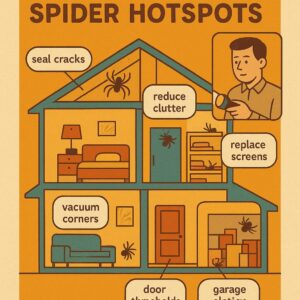
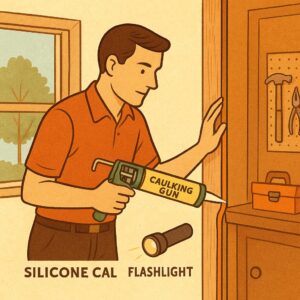
1. Exclusion: Seal the house like a vault. Spiders don’t get in by invitation; they come through cracks, gaps around pipes, torn screens, and under exterior doors. The most effective single investment is a careful perimeter seal. Use silicone caulk on gaps under 1/4 inch, steel wool for larger holes around pipes, and replace torn screens. Why it works: spiders are explorers not engineers—they follow existing pathways into protected, food-rich environments. Block the pathways, and you deny the habitat.
Silicone Caulk and Door Weatherstripping are inexpensive DIY items that cut off common entry points. Professional-grade sealants also last longer and remain flexible through temperature cycles.
2. Sanitation and habitat modification: Remove the buffet. Spiders are drawn to houses with abundant prey: moths, flies, silverfish, and beetles. Reduce those food sources by keeping lights off near doors at night, storing pantry goods in sealed containers, repairing screens, and reducing clutter in attics, basements, and closets. Vacuum corner webs, behind furniture, and under beds on a regular schedule. Why it works: no food equals no long-term population. You can kill existing spiders, but if the food remains, new ones will arrive.
HEPA Vacuum Cleaner models trap tiny insect matter and eggs in sealed bags or containers to prevent re-release.
3. Targeted mechanical reduction: Glue traps and manual removal. Sticky glue traps placed along baseboards, behind appliances, and in dark corners catch wandering spiders and reduce numbers without broad insecticidal exposure. For visible spiders, a quick capture-and-release with a cup and a stiff paper or a dedicated spider catcher tool is effective and humane. Why it works: many household spiders are solitary hunters who roam while looking for prey and mates; intercepting them at travel routes cuts future reproduction.
Glue Traps for Spiders are non-toxic and provide immediate evidence of where spiders are moving in your home.
4. Insecticidal options: targeted sprays and dusts. If populations are high, use pyrethroid-based perimeter sprays for long-lasting residual control on foundation lines and cracks, or insecticidal dusts (silica or diatomaceous earth) in voids and attics where spiders hide. Why it works: these products either repel or kill on contact and have residual action that reduces re-infestation rates. Use with caution: read labels, avoid indoor overuse, and never apply undiluted concentrates where children or pets can access them.
Diatomaceous Earth Food Grade can be applied in thin lines in crawlspaces and attics for a mechanical desiccant effect on insects and spiders.
5. Natural deterrents and scent barriers. Peppermint oil, cedar, and chestnut extracts have modest repellent effects. Use these for short-term deterrence in closets or inside boxes. They are not curative, but they complement other strategies by making small storage areas less attractive. Why it works: many spiders rely on chemosensory cues; strong, unfamiliar scents disrupt their ability to recognize a habitat as hospitable.
6. Professional pest control: when to call in the cavalry. If bites are frequent, population density is high, or you find egg sacs in multiple locations, hire a licensed pest control operator. Professionals bring targeted baits, access to longer-lasting residuals, and expertise about species identification—which matters, because treatment priorities differ for web-building versus wandering hunters. Why it works: trained technicians can identify habitats you may miss, apply treatments safely, and provide a remediation schedule with measurable outcomes.
Professional Pest Control Service search links are a way to find local treatment options and service reviews; always verify licensing and ask for integrated pest management (IPM) approaches rather than indiscriminate spraying.
7. Long-term monitoring and behavior change. Set a maintenance schedule: monthly inspections of basements and attics, seasonal sealing checks, and immediate cleanup of yard debris that could attract prey. Limit outdoor lighting that draws insects close to entry points—use warm-spectrum bulbs and shields that direct light downward. Why it works: the most durable control programs replace reaction with predictable maintenance, interrupting the cycles that allow spiders to reestablish.
Now or Never: Reclaim Your Home and Your Reputation
Spiders are banal in ecological terms and potentially ruinous in social ones. The good news is that the science of prevention is straightforward and often inexpensive: seal, clean, reduce prey, and only escalate to chemical or professional control if simple measures fail. The quicker you act, the less likely the problem will metastasize into the kind of public event that leaves a social scar.
Start this week: walk the exterior with a flashlight, seal the obvious gaps, vacuum the corners you have been avoiding, and place a few glue traps in hidden routes. Keep photographic evidence if you do call a pro—photographs of webs, egg sacs, and bite lines help with species assessment and treatment planning. And remember: most household spiders are more interested in insects than in you. But the social fallout is real, and the only reliable antidote to that fallout is decisive, visible action.
Do the work now. The payoff is both practical and intangible: fewer bites, fewer late-night checks of ceilings, and the slow repair of whatever it was that shifted in other people’s eyes when the chandelier incident happened. Prevent the next public disaster before it starts. The steps are clear; your nervous system deserves the rest.
Leave a Reply