The Night the Bananas Took Over: How Fruit Flies Wreck a Life
Fruit flies are the smallest, most persistent home invaders you never invited. They arrive as a whisper of wings at the kitchen window and, within days, they become a visible, audible verdict on your household hygiene. What starts as a tiny black dot on an overripe peach can quickly traffic into a full-blown infestation that dictates where you sit in the living room, what time you dare to open the back door, and whether you can host friends for dinner without becoming the punchline of someone’s social media post.
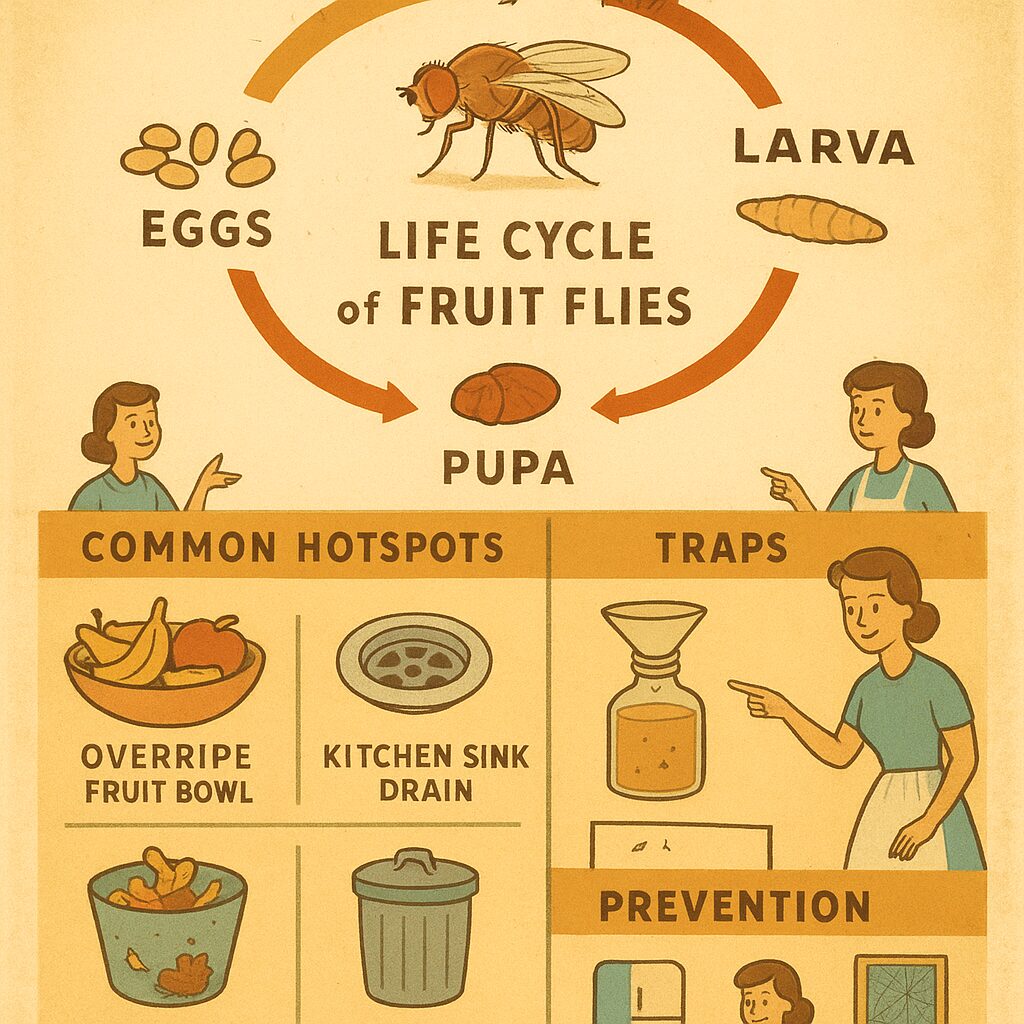
They do not break into your house like burglars, and they do not shout announcements. Fruit flies enter through soft openings—an unzipped window screen, the crack under a door, or hitchhike in on a bag of farmers-market tomatoes. They find the moist, fermenting spots humans ignore until the smell becomes unbearable: a forgotten banana in a bowl, the hidden sediment in a sink trap, the damp towel behind the trash can. Once they have a reliable breeding site, populations explode. Eggs hatch into larvae in under a day. You blink; there are hundreds more than yesterday.
The practical impact is easy to list: ruined produce, contaminated jars and pans, the need to clean spaces you’d assumed were secure. The emotional impact is quieter and more corrosive. Fruit flies make your home feel invaded. They hum at ear level while you try to sleep. They hover over your cutting board like microscopic jurors. You start to see them everywhere: on your glass of wine, on the rim of a soup bowl, on the strap of a child’s shoe. They become a metonym for neglect — an accusation that you are not careful enough, not clean enough, not in control.
The worst of it is social. People are forgiving of one burnt roast or a messy closet. They are less forgiving of flies that sit on their salad. Invitations dry up. Colleagues joke about it once or twice. As eyeballs move to faces on phones, your infestation becomes content: someone uploads a short clip of a dinner party with a fly swarm and tags it with a laughing emoji. That clip stays longer than the dinner did. It travels. It has a half-life much longer than the few sticky traps you set in a desperate midnight cleanup.
I know this because it happened to me.
I run a small catering gig on the side. I’m precise in the way a person becomes precise when their livelihood depends on it: towels folded, ingredients pre-chilled, serving spoons polished. The week it started, I was preparing for a private dinner for twelve in my apartment—a cramped, well-loved kitchen that double-functions as my prep area. Two days before the event, I bought a cluster of bananas for a caramelized-banoffee dessert. I set them on the counter in the usual bowl and got to work on sauces and charcuterie.
I remember the smell first—a faint, almost sweet tang that I registered as an afterthought while I reduced a balsamic glaze. I noticed a single fly, then a second, a black pinprick landing on a banana skin. I shrugged; fruit flies were a thing I had fought before, a minor nuisance. I opened a window and set up a jar trap with apple cider vinegar. I rinsed the cutting board. I scrubbed the sink. A professional would have done more, but I had an event to run.

On the night of the dinner, the air felt thin. Guests arrived polite and hungry. Food came out: warm brioche, roasted pears, the banoffee, a lemon tart. At first, the flies simply landed on the edges of plates and were flicked away with the urbane patience of dinner guests. Then one flew into a woman’s wine. People laughed nervously. A man leaned over his plate and said, “Is that from the kitchen?” I smiled and said it must be a stray. I felt the first twinge of heat in my neck—that flush you get when you realize your competence is on display.
By the second course the pattern became catastrophic. Flies congregated near the sugar bowl, then on a platter of sliced peaches. Someone filmed a short vertical video in dim light; wings caught like silver under a chandelier. Laughter broke into something stiff. A guest got up to find a napkin; when she returned three of her friends were standing in whispered conference, looking toward the kitchen with the terrible clarity of a jury deciding a verdict. Someone whispered, She must have a problem, didn’t she? The hostess’s smile—my smile—stretched and then collapsed. I offered dessert and felt the weight of eyes assessing whether I had failed the most basic standard of hospitality.
After the evening, messages arrived that felt less like gentle feedback and more like memos written in cold type. One client cancelled a booking for the following week and suggested they were “driving across town” to order from elsewhere. Another texted a picture of a fly on a slice of cake and wrote, “Hope that isn’t from you.” A friend forwarded the short video with a laughing caption. I felt humiliated in a particular, modern way: shamed by the camera.
The real collapse came days later. The infestation had spread through the cupboards and into the basement compost bin. When I went to toss an old pineapple core, hundreds of tiny maggot-like larvae you’d rather not visualize wriggled in decomposing pulp; I felt bile climb my throat. I called a pest service. The inspector asked me clinical questions about drains and fruit storage. He said the epidemiology was unmistakable: several breeding hotspots, left unchecked for too long, and a population compoundable in hours. He held up a white card with a dozen tiny flies stuck to it like an accusation. He said I’d need a deep clean, all-food-areas shut and sanitized, and professional drain work. He wrote a note in his clipboard and said, quietly, a couple of the scheduled catering contacts might want to rethink their relationships. He hesitated, then left his card.
That quiet hesitation is what killed me more than the flies. It is the social calculus of cleanliness: once someone stumbles, the ledger marks you.
In the weeks that followed I cleaned until my hands were raw. I replaced screens, deployed traps by the dozens, bleached, steamed, and resorted to enzymatic cleaners in drains. I learned to seal trash like evidence. I stopped leaving fruit on counters. I turned myself into a walking list of best practices. And still, in the small hours, I would wake to the phantom buzz of wings as if my brain had internalized that low-level alarm.
I lost a weekend of bookings. I lost a client who said she “didn’t feel comfortable” with the idea of food prepared in my flat. I lost sleep, and with it a sense of competence I had taken for granted. I kept thinking: for all I had done right, one accidental rot changed everything. If you have ever had a small thing metastasize into a question of character, you know the shape of the collapse. For me, that shape had wings. This is what fruit flies do: they turn a private misstep into a public character judgment and leave you with the awkward task of proving, through hours of scrubbing and sealing and vigilance, that you are not the caricature the camera made you into.
That experience did something practical as well as humiliating: it forced a deep understanding of how fruit flies live, why they choose the spots they do, and what eradication looks like when you refuse to be shamed into inaction. They breed where yeast-fermenting sugars provide both food and moisture. They exploit the microscopic pockets where slow leaks meet organic residue. They are drawn to drains not out of malice, but because your drain is a warm, dark brewery producing the exact chemicals that attract them. Take away those accommodations and you take away their ability to multiply.
There is a difference between panic and protocol. Panic tells you to douse everything in poisons and throw away the kitchen. Protocol gives you a checklist: find the breeding sites, remove the food and moisture, break the life cycle with traps, and then invest in small, surgical changes that prevent recurrence. It is a list built with the same logic that runs through epidemiology, food safety, and common sense. The rest of this article is that checklist, distilled into steps that will let you recover dignity, protect your food, and sleep without the drum of tiny wings at your ear.
Clean, Trap, Seal: The Proven Roadmap to Erase Fruit Flies for Good

If the first section was a confession, this is the manual. Removing a fruit fly infestation is not a single heroic act; it is an organized program that addresses three realities: their food, their water, and their breeding sites. Address those three and you stop the reproductive engine. Here are the strategies that work, why they work, and how to do them well.
1. Audit and Remove the Food Sources
Fruit flies are drawn to fermenting sugars and yeast. That means overripe fruit, sticky spills, exposed jams, open bottles of wine, and even salad dressing left in the sink. The first line of action is ruthless inventory management: throw away old produce (yes, compost the damaged bits only in a sealed outdoor bin), transfer ripe fruit to the refrigerator, and put lids on jars.
Tools to consider: Sticky Fruit Fly Traps for near bowls and trash, and Heavy Duty Mesh Food Covers for outdoor tables or when bringing food to a party. These are simple, passive barriers that cut off access.
2. Clean the Hidden Yeast Factories: Drains and Compost
Drains are a classic breeding ground. Organic matter accumulates in pipe walls and forms a biofilm: a slimy, yeast-rich surface where females lay eggs. Pouring boiling water is a start; enzymatic drain cleaners break down organic films and are more effective long-term than caustic lye. Mechanical cleaning with a brush into the U-bend physically removes the residue.
Try Biological Enzyme Drain Cleaner for maintenance after the initial clearing. For compost and trash, double-bag wet scraps and use sealed outdoor compost bins where flies cannot access the material to breed.
3. Trap Strategically to Break the Life Cycle
Trapping accelerates population collapse by removing adults before they reproduce. Homemade traps are effective: a jar with apple cider vinegar and a few drops of dish soap, or a paper funnel placed in a jar with vinegar. The soap reduces surface tension so flies can’t escape. Place traps near suspected breeding sites: trash, fruit bowls, and drains.
For heavy infestations, deploy a combination of attractant-based traps indoors and sticky traps near windows. Consider purchasing pre-made traps like Apple Cider Vinegar Traps for a ready solution that is discreet and effective.
4. Seal Entry Points and Maintain Environmental Controls
Screen the windows, repair torn window screens, seal gaps under doors, and install tight-fitting lids on trash bins. Pay attention to windows above sinks and garbage chutes where ventilation drafts can funnel flies into living spaces. Small architectural fixes—new door sweeps, mesh screens, sealed compost lids—are inexpensive insurance.
Products that help: Window Repair Screen Patch Kit for torn screens and Sealable Kitchen Trash Can to lock out access to smells and residues.
5. Deep Clean and Routine: The Hygiene Protocol
Schedule a deep clean: empty cupboards, clean shelves, sanitize jars and food containers, and scrub under appliances where crumbs collect. Use an enzyme cleaner on countertops and in sink traps, and follow up with regular daily habits: wash dishes promptly, wipe spills immediately, and store fruit properly. The goal is to reduce the environment to a state that cannot sustain larvae.
6. When to Call a Professional
If you’ve followed the steps and flies persist in large numbers, an inspection by a licensed pest control technician is justified. Professionals can identify cryptic breeding sites (e.g., behind baseboards, inside dishwasher seals, or inside wall voids) and apply targeted treatments that home tools can’t reach. For food businesses, immediate professional remediation is non-negotiable to protect public health and reputation.
For heavier maintenance and a long-term approach, many homeowners combine the above with behavioral changes: weekly drain enzyme dosing, storage of all produce in the fridge if possible, and a rigid trash schedule. These are not glamorous habits, but they are effective. Think of them as the equivalent of oil changes for a car: a small, recurring investment that prevents a breakdown.

Why these methods work: they attack the fly at every point in its life cycle. Removing food and moisture denies adult flies the attractants they use to short-circuit decision-making for egg-laying. Traps remove breeding adults before they reproduce. Enzyme cleaners and mechanical scouring remove the biofilms where eggs and larvae develop. Sealants and physical barriers prevent reinvasion. Together, these steps turn your home from a breeding ground into a hostile environment for Drosophila melanogaster and its cousins.
Recommended toolkit summary: traps (both sticky and vinegar-based), enzyme drain cleaner, mesh food covers, a small drain brush, and durable trash cans with sealing lids. Consider occasional professional inspection if you rely on your kitchen for income or if the infestation is heavy despite rigorous DIY measures.
Fix It Tonight: Why Waiting Will Only Make It Worse
Fruit flies do not negotiate. Every day you delay an organized response you are allowing fast, exponential reproduction. A female can lay hundreds of eggs in her short lifetime; larvae grow quickly in warm conditions. Wait a few days and what could have been solved with a handful of traps and a two-hour deep clean becomes a week-long remediation project that costs money, time, and, if you earn money with your kitchen, clients.
If you’re still feeling embarrassed, remember two things: first, every home experiences pest issues at some point; second, acting decisively and transparently is how reputations are rebuilt. Clean, repair, communicate. Tell clients that you’ve completed professional-grade remediation and list the steps you’ve taken. For friends, a straightforward apology and a promise to host again when things are sorted usually suffices. Most people care more about the quality of a meal than the existence of a previous, rectified problem.
This is not hyperbole: the emotional payoff of reclaiming your kitchen is real. You will sleep better. You will answer texts without flinching. You will host again. The first night after I completed my second professional clean and a week of vigilant follow-up I sat at my counter and drank tea in silence, watching a clean notch of countertop catch the afternoon light. There were no wings; there was no buzzing. That is a small miracle. It is also practical evidence that organized work beats panic and that small, repeated investments prevent catastrophic social fallout.
Do it tonight. Empty the bowl of fruit, refrigerate what’s ripening, set up two or three vinegar traps near the sink and trash, run an enzyme cleaner down every drain, and take out the compost to an outdoor sealed bin. If you have a business, schedule a professional inspection immediately. The actions are simple; the benefits are enormous. In short order, you will replace humiliation with control, and a ruined evening with the quiet dignity of a kitchen that functions the way it should.
Leave a Reply